Cre8te journal
Creator Ad Spend Growth: Data for UGC Agencies
Creator ad spend more than doubled between 2021 and 2024. See what the investment data means for UGC agencies—and the production system clients will expect.
Executive Summary
- Creator content is becoming a real media channel. U.S. creator advertising spend rose from $13.9 billion in 2021 to $29.5 billion in 2024. IAB projected $37 billion for 2025 and expects $44 billion in 2026.
- Brands are reorganizing around social-first production. Unilever has said it wants to move social-first marketing from roughly 30% of spend to more than 50%, while L’Oréal reported €14.18 billion in advertising and promotion expense for 2025 and said 79.2% of its media investment was digital.
- The opportunity for UGC agencies is operational. More money in creator media means more hooks, edits, formats, localizations and refreshes. The agencies that win will sell a repeatable creative-testing system—not just individual videos.
Content creation is no longer a side activity attached to a marketing campaign. It is becoming part of the infrastructure brands use to reach audiences, test ideas and generate demand every day.
The clearest signal is not the number of people calling themselves creators. It is the money moving around them: advertiser budgets, platform payouts, internal content labs and large brands redesigning their marketing operations around social-first output.
For UGC agencies, that shift creates a bigger opportunity—but it also raises the standard. Clients will increasingly expect a reliable system that can transform raw creator footage into a steady stream of testable assets.
Creator advertising has moved from experiment to budget line
The Interactive Advertising Bureau’s 2025 Creator Economy Ad Spend & Strategy Report (opens in a new tab) estimates that intentional U.S. brand investment in creator advertising more than doubled between 2021 and 2024.
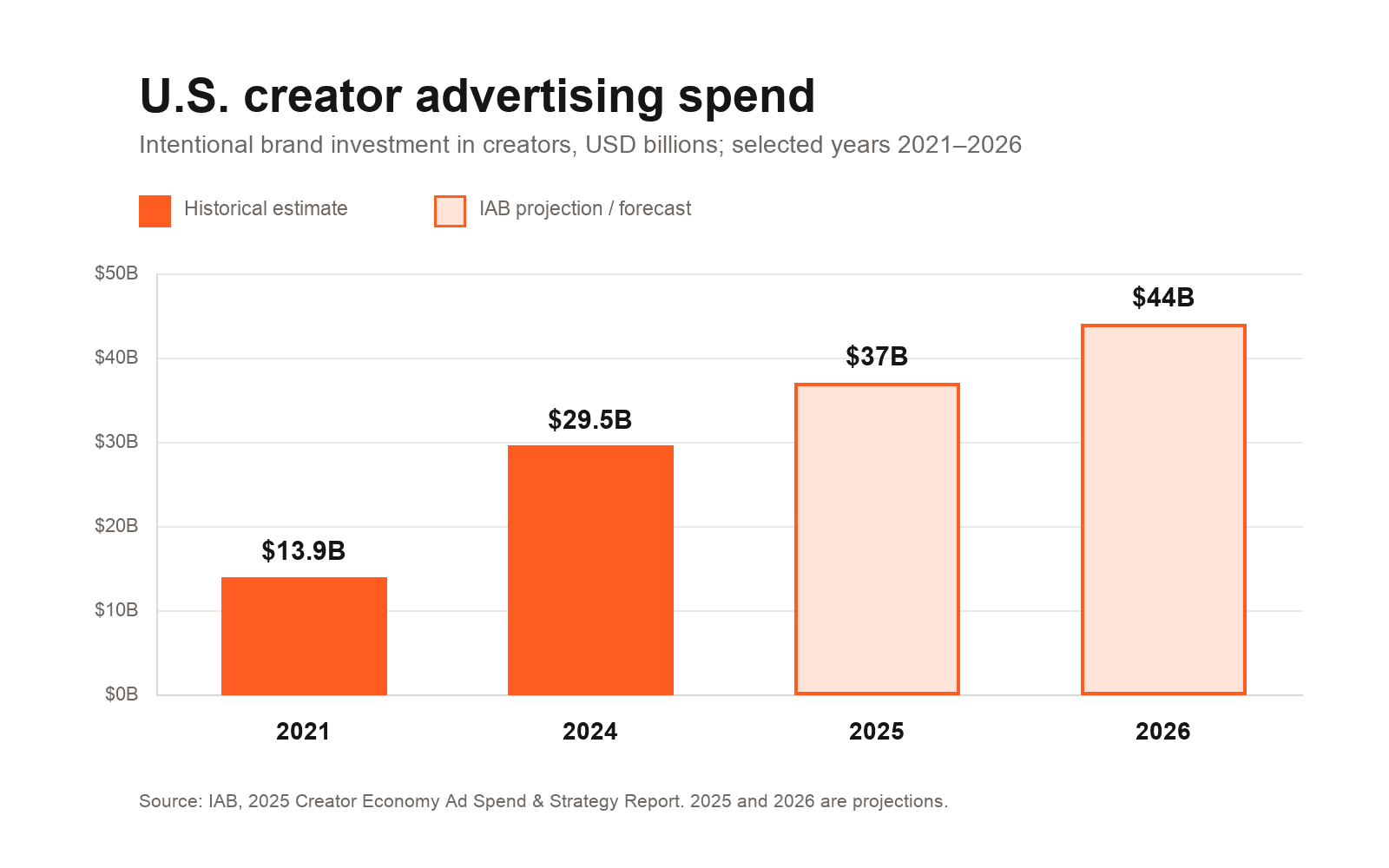
The IAB measure covers deliberate brand spending on direct creator partnerships, sponsored content, amplified sponsored content and planned creator adjacencies. It does not represent the entire creator economy.
IAB projected 2025 creator ad spend to grow 26% year over year—about four times the growth rate it estimated for the broader media market. Among 453 U.S. creator-ad buyers surveyed, 48% described creators as a “must buy.” That figure applies to buyers whose budgets already include creator activity, not to every marketer in the country.
The buying goals are also expanding beyond awareness. In the same research, 43% cited brand awareness, 41% reaching new audiences, 35% reputation or trust, and 32% online sales or conversions as leading creator-campaign goals. Forty percent selected overall ROI as one of their top three creator-campaign KPIs.
That matters because a channel judged on performance needs more than one polished hero edit. It needs variations that can be compared, measured and replaced.
Content creation is becoming a real labor market
The supply side is growing with the demand. An IAB-commissioned study of the U.S. digital economy (opens in a new tab) estimated creator work at 1.5 million full-time-equivalent jobs in 2024—7.5 times its 2020 estimate.
This does not mean exactly 1.5 million people work as full-time creators. The study converts assumed creator income into full-time-equivalent economic activity using a $66,622 national-average annual wage, so smaller earners count fractionally and very large earners can count as more than one FTE. It is a modeled economic estimate—not an official labor-market headcount—and should be read as a directional signal.
Distribution has matured too. The IAB/PwC Internet Advertising Revenue Report (opens in a new tab) measured U.S. digital-video advertising revenue at $78 billion in 2025, up 25.4% from $62.1 billion in 2024. That total covers all digital video—including connected TV, social video, online video and short-form video—not creator advertising alone. And in April 2026, Nielsen measured YouTube at 13.4% of television-set viewing (opens in a new tab), making it the largest media distributor in that month’s Media Distributor Gauge. Nielsen’s measure excludes viewing on phones and computers.
Creator-led video now competes for budgets and attention across phones, feeds and television screens. The practical consequence is an expanding need for production capacity.
Major companies are shifting investment toward content systems
Unilever made the operational change unusually clear at its November 2024 investor event. The company said it needed to increase social-first marketing from approximately 30% of spend to more than 50% in the near future. Its Beauty & Wellbeing business separately described a plan to move social from roughly 20% to 50% of digital media investment.
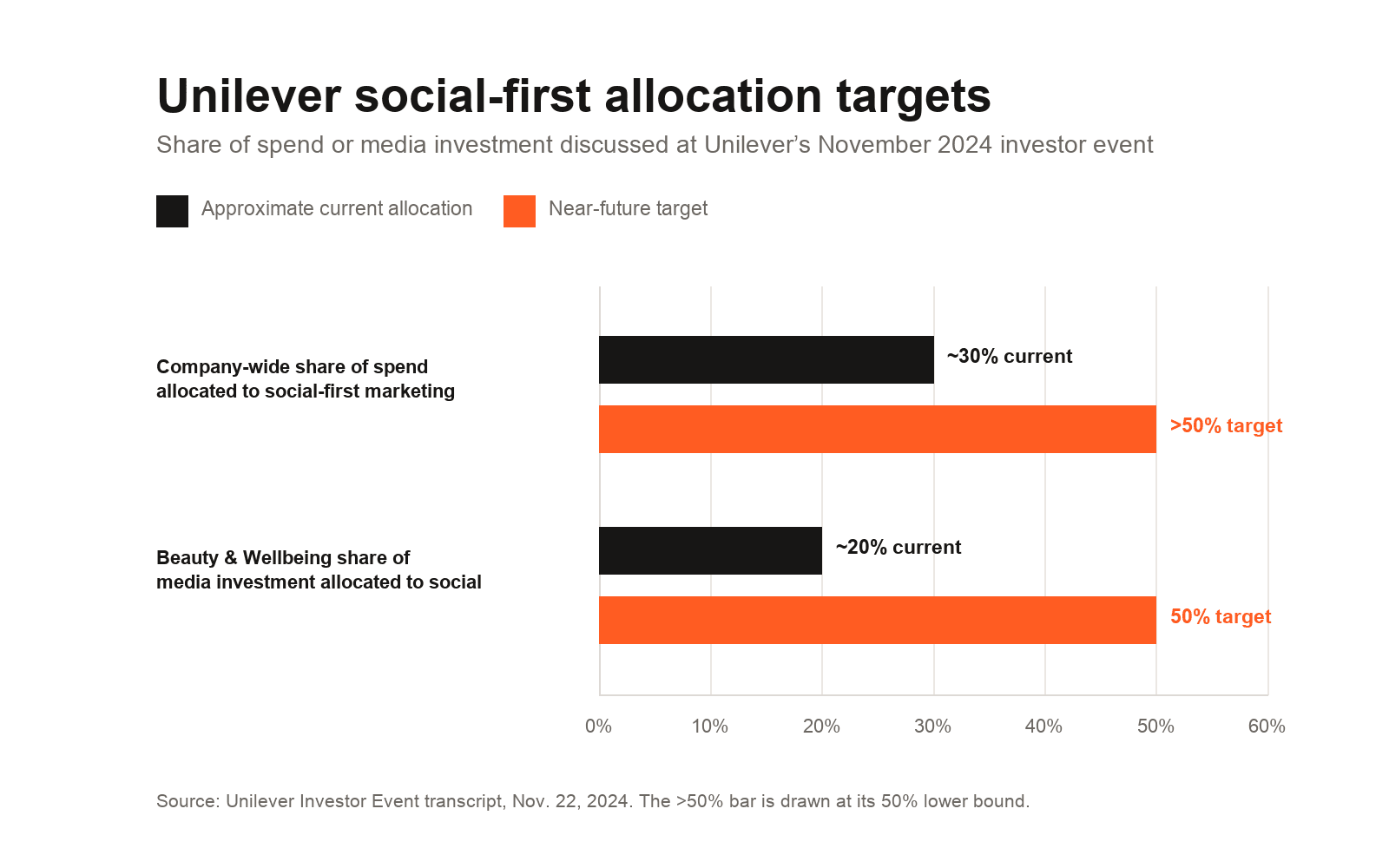
Source: Unilever Investor Event transcript, November 22, 2024 (opens in a new tab). These are stated allocation targets, not reported completed results, and the two rows use different spending scopes.
The same presentation described a TRESemmé Thailand program producing more than 200 always-on assets. The important lesson is not that every brand needs exactly 200 pieces of content. It is that a large advertiser now thinks in terms of a continuously operating content engine.
L’Oréal offers another view of that scale. Its 2025 consolidated income statement (opens in a new tab) reported €14.18 billion in advertising and promotion expenses. The company said 79.2% of media investment was digital (opens in a new tab) and described an internal content lab capable of producing more than 495,000 assets per month (opens in a new tab).
Those figures are not UGC budgets, and an internal content lab is not the same thing as an agency. They show the direction of travel: major advertisers are building for greater volume, more formats and faster adaptation.
Platforms are funding the supply side
Platforms are also putting substantial money into creator ecosystems:
| Platform | Publicly disclosed payout | Scope and period |
|---|---|---|
| YouTube | More than $100B | Paid globally to creators, artists and media companies over the four years preceding September 2025 |
| Nearly $3B | Paid to content creators through monetization programs during 2025 | |
| Spotify | More than $100M | Paid worldwide to podcast publishers and podcasters in Q1 2025 |
These numbers are not directly comparable. They cover different formats, recipients, markets and time periods. They should not be read as a ranking. Together, they show that major distribution platforms have strong financial incentives to keep professional creators producing.
Sources: YouTube (opens in a new tab), Facebook (opens in a new tab) and Spotify (opens in a new tab).
What this means for UGC agencies
The market does not simply need more videos. It needs a better process for creating, learning from and replacing them.
1. Sell a testing system, not a single deliverable
A “UGC video” is an output. A creative-testing system is an ongoing business capability.
An agency can turn one well-planned creator shoot into a variation matrix:
- 4 hooks
- 2 body structures
- 2 calls to action
- 2 caption or pacing styles
That produces up to 32 possible combinations before changing the creator, offer or format. Not every combination should be exported automatically; the point is to capture footage modularly so the strongest ideas can be recombined quickly.
2. Design the brief for the edit
The editing bottleneck often begins before footage reaches an editor. A production-ready creator brief should request:
- Clean hook takes with a pause before and after each line
- Multiple product demonstrations and reaction shots
- Separate proof points rather than one long monologue
- Several calls to action with different levels of urgency
- Room for on-screen text and safe cropping across aspect ratios
- Explicit usage rights, brand-safety restrictions and pronunciation notes
This turns raw footage into reusable creative inventory instead of a one-time recording.
3. Protect authenticity while professionalizing operations
Creator content works because it feels human. Production systems should preserve that voice—not sand it down until every creator sounds like the same advertisement.
The repeatable layer belongs behind the scenes: file naming, selects, captions, version control, review stages, music licensing, brand checks and delivery specs. The performance and point of view should still belong to the creator.
4. Make measurement part of delivery
If clients care about ROI, agencies should connect editing decisions to results. At minimum, each delivered variation should have a stable ID that links the creative to:
- Hook and opening visual
- Creator and concept
- Offer and call to action
- Length and platform format
- Spend, hold rate, click-through rate and conversion result
The goal is not to claim that an edit alone caused performance. It is to create a feedback loop in which the next batch is informed by the last one.
A practical 30-day operating model
An agency can start building this system without buying a complicated platform:
- Week 1 — Define the test. Choose one audience, one offer and three or four hook hypotheses. Agree on success metrics before production.
- Week 2 — Capture modular footage. Record hooks, proof, demonstrations, objections and calls to action as separate building blocks.
- Week 3 — Produce the first variation set. Launch a controlled number of meaningfully different edits rather than dozens of cosmetic changes.
- Week 4 — Review and iterate. Identify which creative elements correlate with stronger results, document the learning and commission the next batch.
This makes the agency more valuable than a source of editing labor. It becomes the operating layer that helps a client learn faster.
How to read the numbers
The data in this article measures several different parts of the market:
- IAB creator ad spend is intentional U.S. brand investment in creator advertising—not total creator income.
- Goldman Sachs has separately estimated the broader creator-economy market could grow from about $250 billion in 2023 to $480 billion by 2027, but that broader estimate includes revenue sources such as subscriptions, affiliate links, tips and merchandise.
- Unilever and L’Oréal figures describe company marketing allocations and production capabilities, not spending reserved specifically for UGC agencies.
- Platform payout figures use different time periods and include recipients beyond individual UGC creators.
Projections are not guarantees. Definitions will continue to evolve as platforms, agencies and advertisers change how they classify creator media. The durable conclusion is simpler: more money, labor and distribution are organizing around content creation, and that increases the value of reliable creative operations.
The agency opportunity
The rise of content creation does not eliminate the need for agencies. It changes what the best agencies are hired to do.
The winning offer is no longer “we can edit your video.” It is: we can help you turn creator footage into a dependable learning and growth system.
Cre8te gives agencies a managed team for UGC video editing, short-form production and ongoing agency video editing—without adding another full-time editor. See how the subscription works.
Sources and further reading
- IAB: 2025 Creator Economy Ad Spend & Strategy Report (opens in a new tab)
- IAB: Measuring the Digital Economy 2025 (opens in a new tab)
- IAB/PwC: Internet Advertising Revenue Report, Full Year 2025 (opens in a new tab)
- Nielsen: April 2026 Media Distributor Gauge (opens in a new tab)
- Unilever: November 2024 Investor Event transcript (opens in a new tab)
- L’Oréal: 2025 consolidated income statement (opens in a new tab)
- Goldman Sachs Research: The creator economy could approach $480B by 2027 (opens in a new tab)
Put the workflow into practice
Explore managed editing for UGC agencies.
See how Cre8te turns creator footage into organized, review-ready variations without another full-time editing hire.
View UGC editing services